// The systems read, in writing
The "Simple Initially" Tax: What Slack’s SSH Migration Teaches Us About Engineering Debt
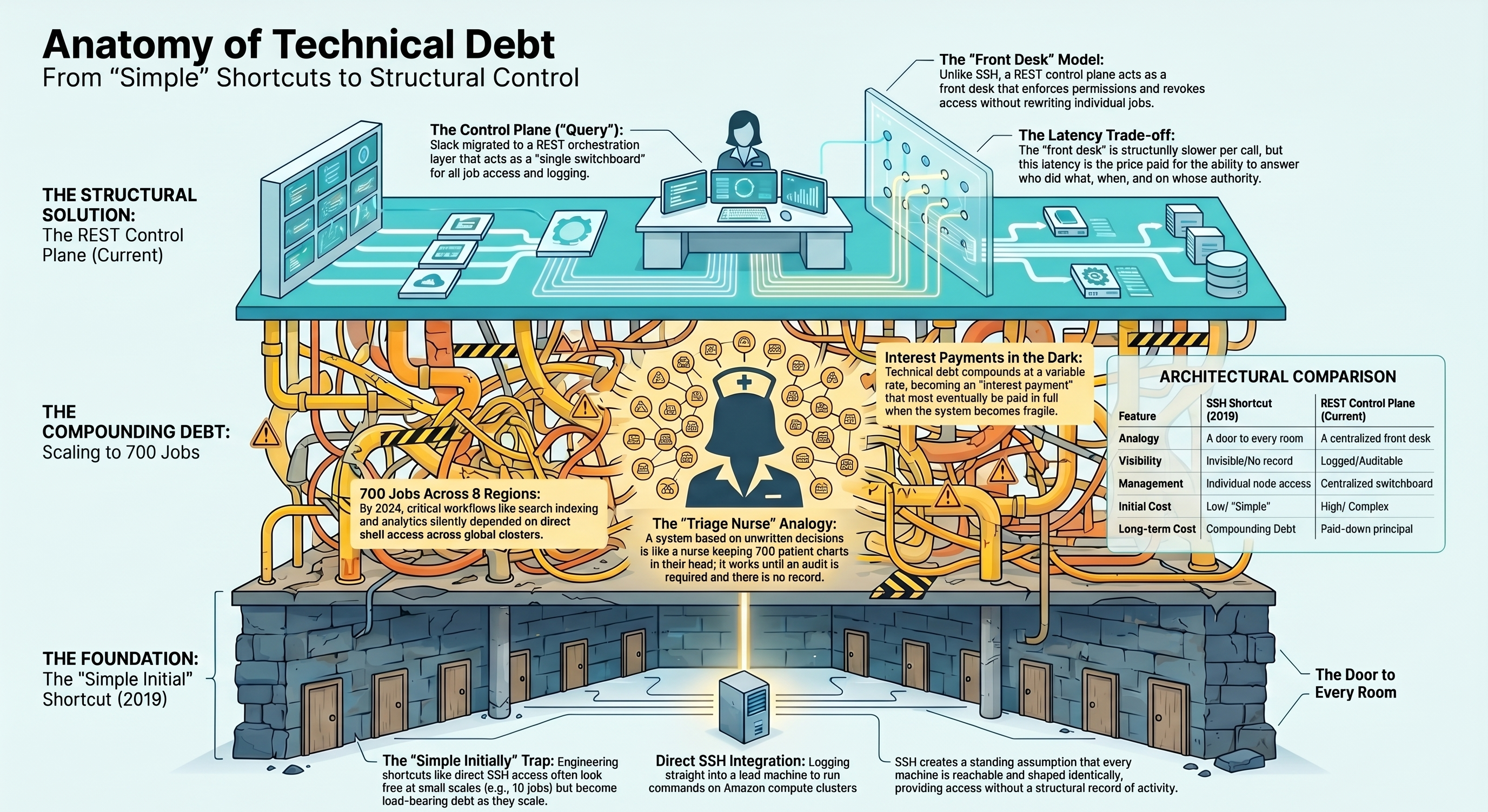 Download the one-page infographic
Slack recently stripped SSH—a direct, shell-level remote login method—out of its production pipeline. If you read the official change log, you’ll see it filed under "good hygiene" or a "standard security upgrade. " But if you’re reading the architecture instead of the press release, you’ll see something far more instructive: this wasn't a proactive security win. It was a debt notice. What we are witnessing is the final bill for a technical shortcut taken in 2019—a decision that was re-architecting a brittle primitive five years too late. It is a masterclass in how "small" decisions evolve into load-bearing structures that eventually demand a massive, forced migration.
1. "Simple Initially" is the Most Expensive Phrase in Engineering
In 2019, Slack needed a scheduler to execute jobs on big rented compute clusters at Amazon (AWS). The path of least resistance—the "simple path"—was to have the scheduler log directly into the lead machine via SSH and execute commands. It was a classic engineering move: it worked for 10 jobs, it was shipped on a Tuesday, and it was never thought about again. But the "simple" solution for a handful of jobs becomes a catastrophic liability when it scales to 700 jobs across eight different regions. This shortcut wasn't just an implementation detail; it became a load-bearing pillar for search indexing, analytics, and the very systems the business runs on. "Simple initially is the most expensive phrase in engineering. It's how every loadbearing shortcut gets approved. "
2. It’s Not a Security Win; It’s a Debt Notice
While framing this as a security improvement makes for a clean narrative, "good hygiene" in a change log is often just a euphemism for a bill finally coming due. In this case, security risks were merely the symptom; the disease was a structural failure caused by undocumented decisions and invisible dependencies. The disease took root because nobody SSHs into a single node and simply stops there. By 2024, the business’s core workflows silently depended on direct shell access to live clusters. To call this "security theatre" would be uncharitable, but viewing it strictly as a security story misses the point. The architecture had become fragile because it relied on a method that was never intended to support that level of scale. As the source notes, " Good hygiene is doing real work in that change log"—it’s the polite way of saying the architecture broke and the bill had to be paid.
3. The Door vs. The Front Desk (The Power of a Control Plane)
The solution was a transition from SSH to a REST orchestration layer dubbed " Query. " This move wasn't about using modern protocols for the sake of being modern; it was about moving from a reliance on tribal memory to a formal system of record. Think of the old SSH method like a brilliant triage nurse who keeps every patient chart in their head. That nurse is a hero when you have 20 patients, but at 700 patients, that nurse becomes the ultimate bottleneck. The system fails the moment you need an audit because there is no record beyond one person's memory. The " Query" REST layer introduces a control plane—a single switchboard that provides a functionality SSH structurally lacked: the ability to revoke access without anyone rewriting the job.
SSH (The Door): Direct access, zero observability, no record of entry, and a total reliance on tribal memory.
REST (The Front Desk): Centralized orchestration, mandatory audit trails, and decoupled permissioning that allows for global changes without breaking individual workflows. "SSH gave you a door to every room, and no record of who walked through. Rest gives you a front desk. "
4. The Interest Rate Resets When the Shortcut Goes Load-Bearing
Every easy integration is essentially a loan. You do not avoid the cost of a proper architecture; you simply defer it. This interest compounds in the dark until the balance must be paid in full. The SSH shortcut created a "standing assumption" that every machine would always be reachable and shaped in the exact same way forever. Because no one "owns" or reviews a standing assumption, it remains invisible until the day it owns you. Eventually, the scale of the operation reached a breaking point. At 700 jobs across eight regions, Slack didn't choose this migration schedule; the debt chose it for them. Technical debt never asks for permission before it collects; it simply reaches a point where the interest rate—which is always variable—resets the moment the shortcut goes load-bearing.
5. Conclusion: Pricing the Shortcut on Day One
The core lesson for any systems architect is the importance of tracing the dependency graph before trusting a headline. The shortcut that ships today is borrowed time, and the "audit you can't run yet" is its own episode of failure waiting to happen. Winning engineering teams are those that "price the shortcut" on the day they take it. They recognize that while swapping SSH for a REST control plane is a standard part of platform maturation, doing it on your own schedule is a luxury bought by early architectural discipline. Look at your own stack: Which "simple initial" decisions are currently compounding interest in the dark? Which of your standing assumptions are one scale-up away from a forced migration? The deferred decision is the real story—make sure you're the one reading the balance sheet before the debt collector arrives.