// The systems read, in writing
The Boring Moat: Why Google’s "Slow" Design Choice is Winning the AI Hardware War
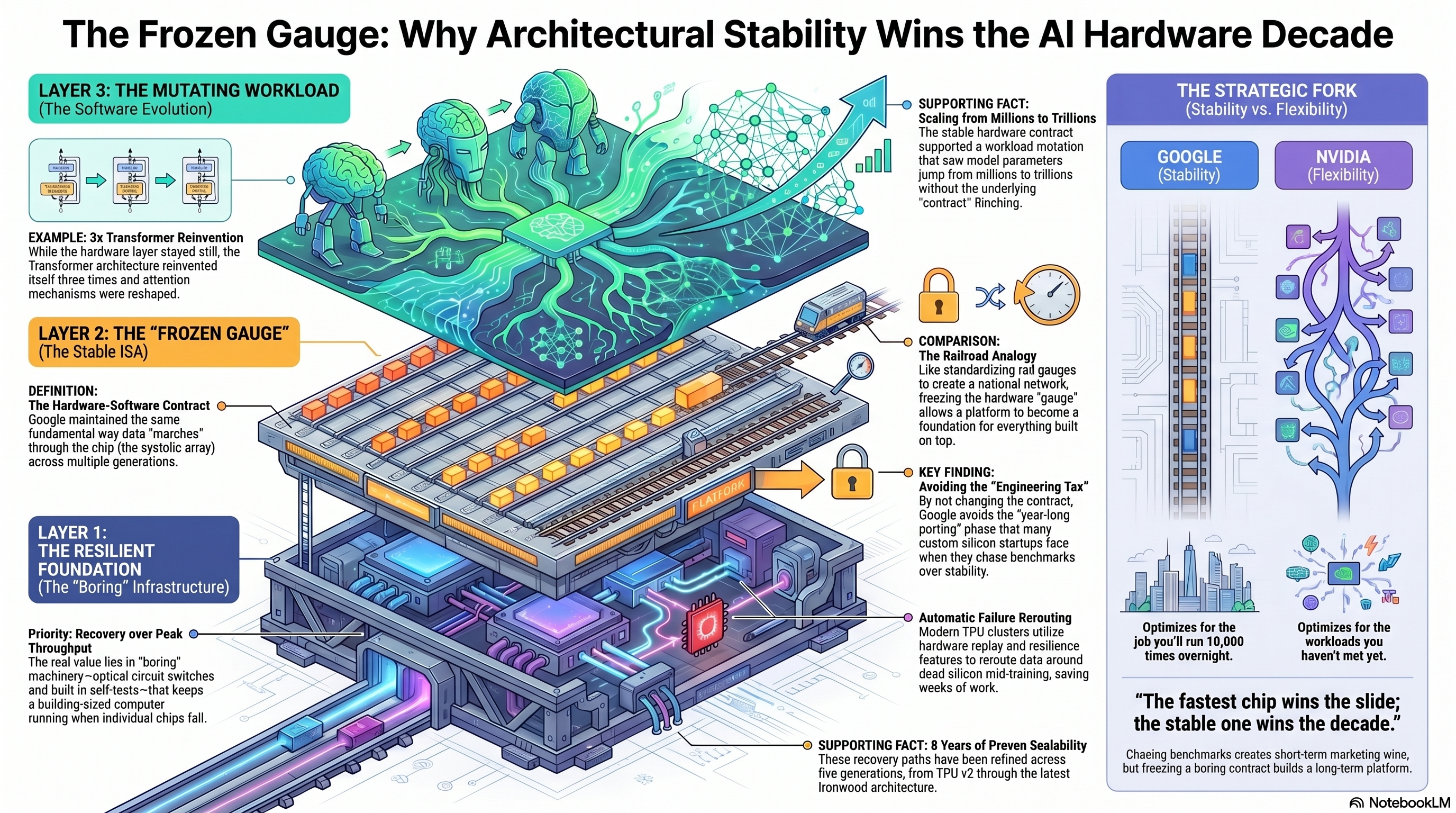 Download the one-page infographic
Google recently published a landmark paper that most of the industry is currently reading backward. Documenting eight years of training supercomputers across five generations of Tensor Processing Units (TPUs)—from version 2 through Ironwood—the paper is being mined for performance charts and peak "flops. " But if you’re only looking at the speed and feed story, you’re missing the actual architecture of a monopoly. While the "press release" metrics look impressive, the real strategic secret is hidden in plain sight. If you study what Norman Jouppi and Turing Award winner David Patterson actually documented, the load-bearing detail isn't peak throughput. It is a series of "boring" design choices that prioritize architectural stability and recovery over raw benchmarks. This is the " Boring Moat," and it is currently swallowing the competition.
Peak Throughput is a Vanity Metric; Resilience is the Reality
In the silicon world, there is a seam everyone is stepping over : the gap between the chip that wins the keynote and the chip that survives the quarter. Most labs announce a faster chip built for the slide deck, but the reality of running a building-sized computer at 3:00 AM is far less glamorous. When training frontier models, a single chip failure used to mean jeopardizing weeks of work and millions of dollars in compute time. In a massive cluster, the "recovery path" is the only metric that matters. Google’s TPU evolution isn't just about speed; it's about optical circuit switches, hardware replay, and built-in self-tests. By prioritizing these resilience features, Google created machinery that can automatically reroute around dead silicon mid-run. This allows a training job to continue even when hardware fails. As the authors note, the true achievement isn't the velocity of the machinery, but the systems that keep it running when a single component dies. The headline number is what you put on the keynote; the recovery path is what you bet the quarter on.
The Power of the "Frozen Gauge"
To understand Google’s strategic advantage, look at the history of the railroad. Early rail networks were a fragmented mess of incompatible track gauges, with every region using a different width. Even the fastest locomotives were useless because they couldn't cross the "seams" between networks. The systems that won weren't the fastest; they were the ones that picked a gauge, froze it, and built a platform on top of that single, inflexible decision. Google has applied this "frozen gauge" philosophy to silicon via a stable Instruction Set Architecture (ISA) . This is a fixed contract between hardware and software. In an industry obsessed with "new," Google realized that the thing that compounds is the part you refuse to change. Freezing the gauge wasn't a limitation—it was the creation of a platform that allowed years of software optimization to accumulate without the need to renegotiate the underlying interface every year.
The Invisible Contract vs. The Mutating Workload
At the core of this frozen gauge is the systolic array . This is the fundamental way data "marches" through a TPU, and Google has barely touched this mechanism across five generations. The brilliance of this stability becomes clear when you look at the volatility of AI workloads. Over the last eight years:
The Transformer architecture reinvented itself three times.
Attention mechanisms were completely reshaped.
Models mutated from millions of parameters to trillions. Despite the total transformation of the workload, the underlying hardware contract—the systolic array—didn't flinch. Why? Because while the architecture of the models changed, the fundamental math (matrix multiplication) did not. By holding the contract still, Google’s software layers could evolve at breakneck speed on a foundation that never moved. While other teams spent thousands of engineering months "re-qualifying" software for new, incompatible architectures, Google’s value was compounding.
The Strategic Fork: Stability vs. Flexibility
The silicon industry has taken two different sides of a massive bet. On one side is NVIDIA, whose CUDA platform wins through flexibility . CUDA is designed to "bend," capturing every experimental workload that a more rigid design might miss. This is an optimization for discovery . Google’s bet is on stability . While "stability" and "lock-in" are two sides of the same coin, they solve distinct problems:
Flexibility optimizes for the workload you haven't met yet (the "demo").
Stability optimizes for the workload you will run 10,000 times overnight (the "frontier training"). Training a frontier model is not a five-minute demo; it is an "overnight job" that lasts for months at a scale where faults are inevitable. Many custom silicon startups fail because they chase the benchmark, ship the faster number, and rewrite their hardware-software contract every cycle to achieve it. They effectively pay in engineering months for a performance win that only looked "free" on paper.
Conclusion: Winning the Decade, Not the Slide
We are entering a period of massive industry consolidation. My prediction: within the next 24 months, half of the custom silicon startups bragging about peak flops today will have quietly frozen their architectures or died under the weight of rewriting their software contracts. The lesson from the TPU's journey is clear: the fastest chip wins the keynote slide, but the stable architecture wins the decade. In the world of high-stakes AI, the most "boring" decision—refusing to change the gauge—is often the most lethal competitive advantage. As you look at your own infrastructure or investments, the critical question remains: are you architecting for the five-minute demo, or the three-month training run?