// The systems read, in writing
The Myth of the 500 FPS Ball: What’s Really Powering the World Cup’s Offside Tech
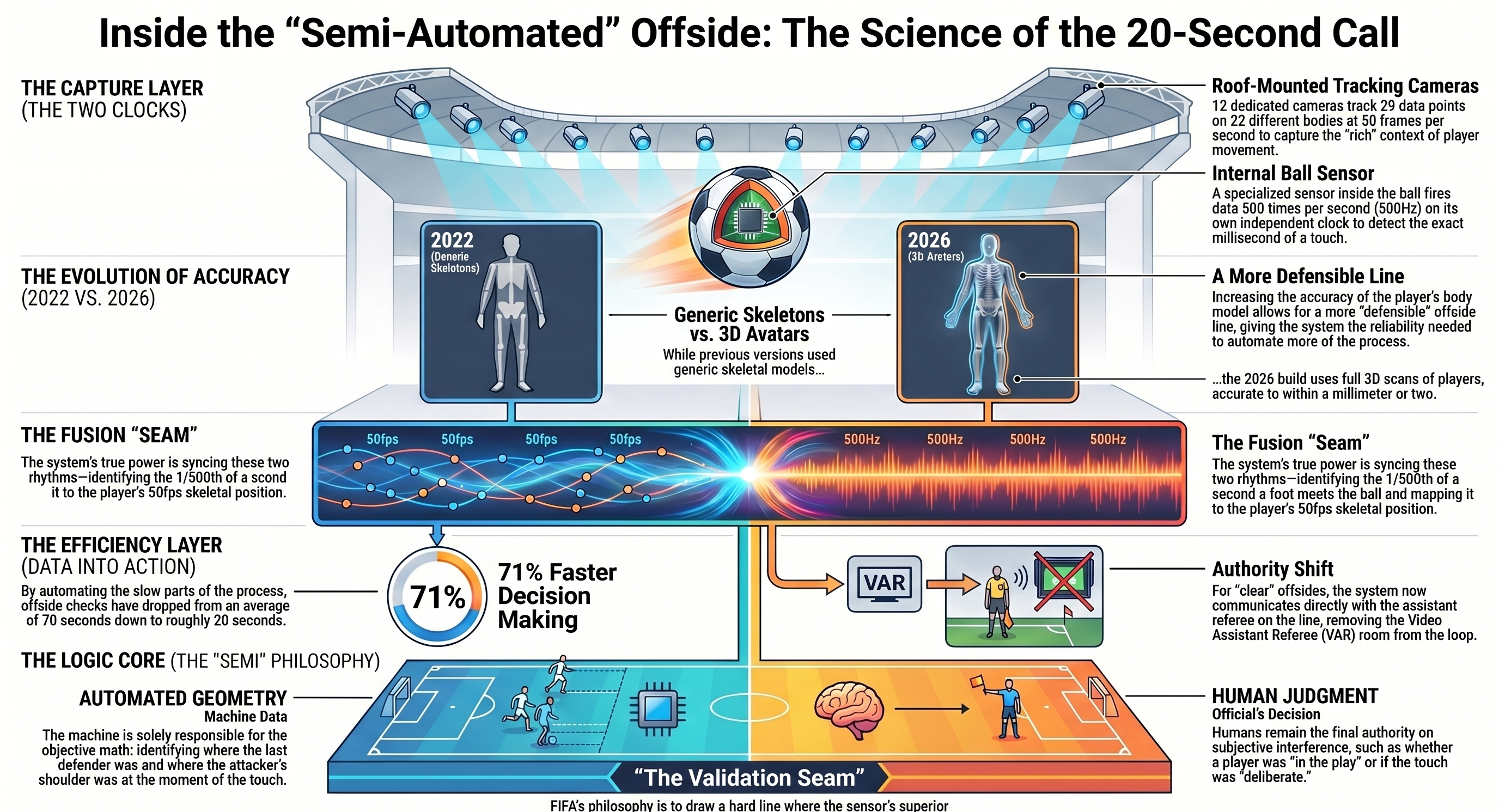 Download the one-page infographic
Introduction: The Viral Spec vs. The Reality
In the lead-up to international football’s biggest stages, one specific statistic tends to dominate the tech discourse: the claim that the ball tracks data 500 times a second. It is a clean, impressive, and deeply seductive number that suggests a level of total digital surveillance. However, as any systems analyst will tell you, the most "viral" version of a technical spec is rarely the most interesting one. The true engineering feat of FIFA’s offside technology isn't found in a single high-speed sensor, but in "sensor fusion"—the grueling synchronization of two entirely different instruments running on two different clocks. By deconstructing the marketing hype, we find a system designed around the "seam" between human judgment and machine precision. This isn't just a story about speed; it is about the deliberate choice of what to automate, what to refuse, and the shifting boundary where the machine ends and the referee begins.
The "Two-Clock" Illusion
The "500 data points per second" claim is a marketing weld—a fusion of two different instruments into one impressive figure because, frankly, a big number sells. To understand the system, you have to look at the friction between its components:
The Roof Cameras: These track up to 22 players on the pitch, capturing 29 specific body points—shoulders, knees, and the boots that decide a goal. These cameras run at 50 frames per second . This is "slow" data, but it is rich, capturing the complex geometry of 22 bodies at once.
The Ball Sensor: Hidden inside the ball is a sensor that fires 500 times a second on its own independent clock. This is "fast" data, but thin, tracking only one object. The intelligence of the system lives in the discrepancy. Like a pit crew where the tire gun and the jack operate on different rhythms to achieve a single clean stop, the software’s job isn't to make these rates match. It is to find the exact half-second where they align. The system must pinpoint the precise millisecond the foot met the ball (using the 500fps clock) and then ask exactly where every player's shoulder was at that identical instant (using the 50fps clock). The "seam" is where the decision is born.
From Generic Skeletons to Millimeter-Perfect 3D Models
While previous iterations of the technology—like those seen in Qatar—relied on generic skeletons that were "close enough" for a digital representation, the roadmap for the 2026 tournament moves the needle toward full 3D scans. These models are accurate down to a millimeter or two. As a systems analyst, I see this as much more than a graphics upgrade for the broadcast. This is about establishing a "defensible line. " When the system can prove with millimeter precision where a player's anatomy was in relation to the defender, it gains a level of authority that a generic avatar simply cannot command. In the high-stakes theater of a World Cup, the phrase "this time the avatar on screen is you" carries weight; it transforms a computer-generated line into an unassailable record of fact.
The Machine Earns Its Own Voice
As the system’s precision has reached this defensible threshold, FIFA has overseen a quiet but fundamental transfer of sovereignty. In previous iterations, every automated call was sent first to a video room where a human official checked the data before radioing the field. Now, for clear offside calls, the system talks straight to the assistant on the line. By allowing the video room to drop out of the loop for the "easy ones," the machine has effectively earned a level of authority it did not previously possess. This is FIFA quietly deciding the tech has earned a step of human review it used to require. It is a milestone in human-in-the-loop dynamics: the machine has moved from being a tool for consultation to a participant with a voice.
The 50-Second Shave (And Why It Matters to Fans)
The primary benefit of this machine authority is the elimination of "dead air"—the agonizing minutes where players and fans alike stare at a screen, waiting for a verdict. Pierre Luigi Kina, who oversees the referees, highlights the efficiency gains with a staggering data point:" An offside check that used to burn around 70 seconds now lands in roughly 20. "This time saving wasn't achieved by making humans think faster. It was achieved by moving the "slow part" of the process—the geometry and line-drawing—to the machine. By automating the mechanical aspects of the check, the officials can focus their time on the elements of the game that actually require human intervention.
The "Semi" Philosophy: Geometry vs. Judgment
Despite the high-speed sensors, the core philosophy of the project is contained in a single syllable: " Semi. " FIFA is careful to label the system as " Semi-Automated" because they have drawn a hard line between geometry and judgment. Johannes Holtz Müller, FIFA’s technology director, is consistent on this point: the system judges position, not intention. The sensors can determine if a player was past the last defender, but they cannot judge:
Interference: Was the player actively involved in the play?
Intent: Did the player mean to play the ball?
Deliberate Touches: Was the contact a controlled play or a deflection? These nuances remain the domain of the human official. The most compelling part of this story isn't what FIFA automated; it’s what they refused to automate. They identified what a sensor does better—measuring distance and time—and stopped exactly where human interpretation begins.
Conclusion: The Shifting Seam
The current state of football technology is defined by the "validation seam"—the point where the machine finishes its measurement and hands the call back to a human. This is the honest version of the AI story: it isn't about the part of the process that vanished, but the part they kept. As we look toward 2026, we must recognize that this seam is not stationary. As cameras get faster and scans get richer, the machine’s role will inevitably slide toward the official, one call at a time. I find myself circling back to that secondary clock—the one firing 500 times a second inside the ball. It is a sophisticated computer hidden in a thing a striker swears is leather, and it is changing the nature of the sport. The question for the next tournament is not just about the speed of the data, but whether we will ever reach a day where a sensor is asked to rule on "intent. " For now, the machine measures the geometry, while the human still owns the game.