// The systems read, in writing
Why GitHub is Breaking: The Surprising Reason Three Rivals Just Teamed Up Against the Giant
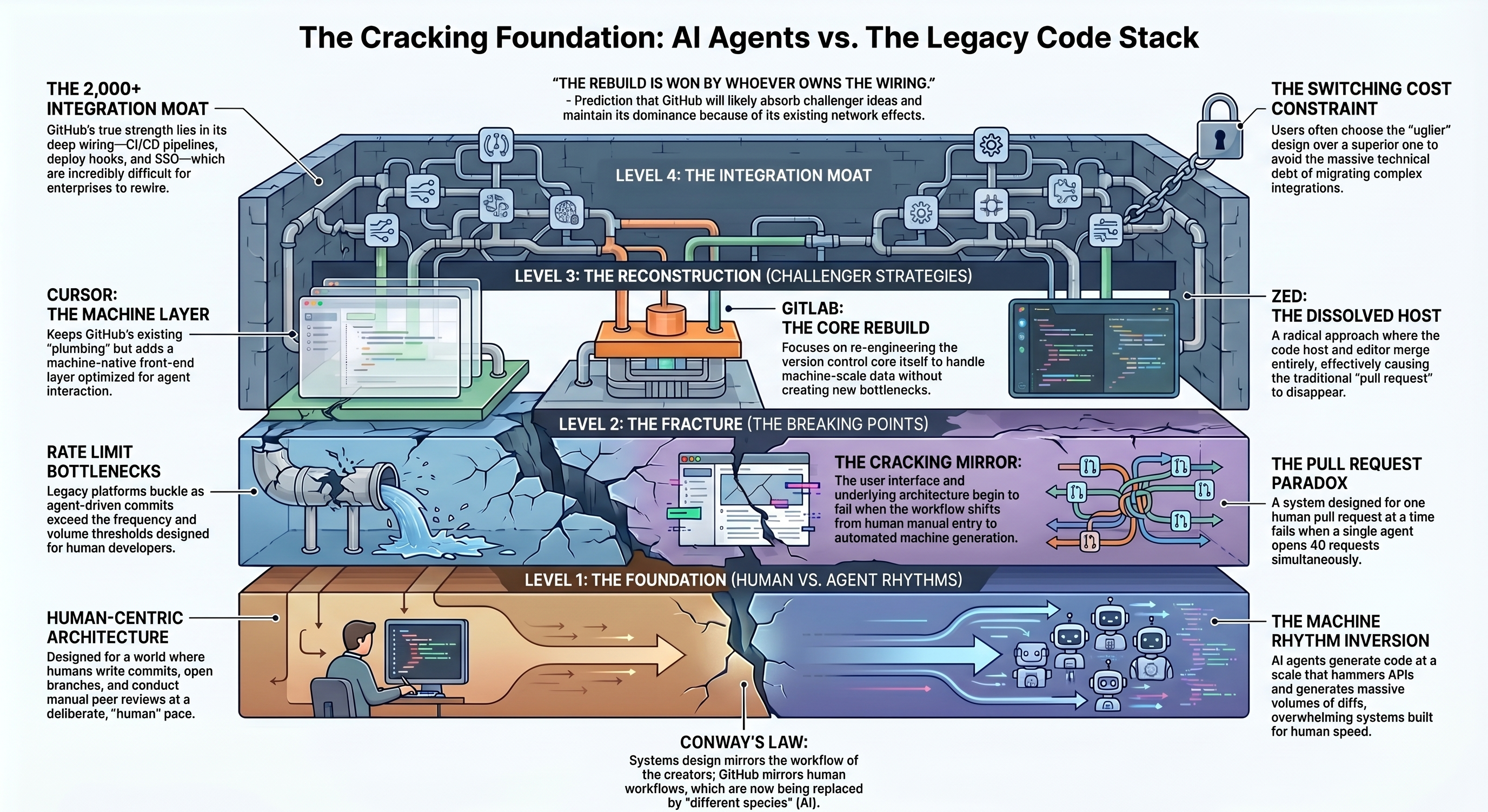 Download the one-page infographic
In an industry defined by zero-sum competition, a consensus between Cursor, GitLab, and Zed isn't just a coincidence—it’s a fire alarm. When a single startup claims an incumbent is obsolete, we call it marketing. But when three fierce competitors, each placing radically different bets on the future of code, reach the exact same diagnosis, we are witnessing a foundational shift. The shared realization? GitHub is breaking. Not because it’s missing a feature or needs a UI refresh, but because it is built on a "cracked" foundation of human-centric assumptions. The platform isn't just old; it is evolutionary software designed for a different biological rhythm.
The Inversion: Why 40 PRs per Hour Breaks the System
GitHub was architected for a world where humans write the commits. The entire system—the review models, the user interface, even the rate limits—assumes a " Human Pace. " In this legacy model, a person opens a branch, writes code, submits a pull request (PR), and waits for a human peer to review it. We are now seeing a " Machine Rhythm" that is causing a total load profile inversion. The transition from human developers to AI coding agents has turned a steady stream into a flash flood:
From 1 to 40: Where a human developer opens one PR and waits, an AI agent can open 40 simultaneously.
Velocity as a Weapon: An agent can generate more "diffs" (code changes) in a single hour than a human team produces in an entire week.
The Choke Point: These agents are "hammering" the programming interface (API) at a frequency that causes systems to buckle. Rate limits, which were originally designed as "breathing room" for human review, are now being choked out by machine-scale workloads. The platform isn't just slow; it’s architecturally mismatched for the volume of its new primary users.
When a Workflow Changes Species (Conway’s Law)
This conflict is a visceral illustration of Conway’s Law: systems mirror the workflows of the organizations that built them. GitHub mirrors a human workflow because it was built by humans for humans. As the industry shifts toward AI-driven development, the fundamental mismatch becomes undeniable:" A systems design ends up mirroring the workflow that built it. GitHub mirrors a human workflow. When the workflow changes species, the mirror cracks. "This isn't a "scaling" problem you solve by throwing more database capacity at it. It is an evolutionary crisis. When your workflow changes species—from human to agent—the infrastructure built for the previous species becomes a cage.
Three Rivals, Three Radical Rebuilds
While the diagnosis is unanimous, the prescription is where the industry’s most high-stakes experimentation is happening. Cursor, GitLab, and Zed are following three diverging paths to solve the machine-native problem:
Cursor: Focuses on a machine-native front-end. They are betting they can keep GitHub’s existing "plumbing" while wrapping it in a sophisticated AI-native layer.
GitLab: Aims for the foundation. They are rebuilding the version control core itself for machine scale, operating on the premise that "bolting" AI onto an old core just moves the bottleneck further down the pipe.
Zed: The most radical line of all. In Zed’s model, the code host dissolves into the editor entirely. The agent never leaves the workspace, the "pull request" as we know it disappears, and the friction of the external host is eliminated.
The Wiring Trap: Why Better Design Doesn't Equal Market Share
Here is the counter-intuitive twist: the challengers might be 100% right about the design and still lose the market. GitHub’s moat isn't its "pretty box" UI—it’s the " Wiring Trap. "Every CI/CD pipeline, every deployment hook, every enterprise SSO, and every automated bot in the modern enterprise is currently wired into GitHub. Network effects are brutal; they prioritize existing wiring over architectural purity. As the industry reality dictates:" Nobody wants to rewire 2,000 integrations. "A challenger can build the most elegant, machine-native environment in history, but if it requires a developer to rip and replace their entire infrastructure, the inertia of the incumbent will win every time. Network effects don’t care if your design is dated.
The "Ugly" Winner Prediction
The winner of this transition won't be the one with the most aesthetic AI interface. It will be the one who solves machine scale without forcing a painful migration. My prediction: Within a year, GitHub will ship an agent-native mode that quietly adopts the challengers' best ideas. It might be "uglier" and less elegant than what Zed or Cursor offers, but it will work with the existing 2,000 integrations. In this scenario, the loudest challengers will either be acquired or forced to pivot. The rebuild is won by whoever owns the wiring, not whoever draws the prettiest box. GitHub will survive being "wrong" about the foundation by being "right" about the cost of switching.
Conclusion: The Real Constraint
The transition from human-native to agent-native coding is inevitable, but the battle for the code host is a war of infrastructure, not aesthetics. The real constraint isn't "how do we make AI code? " but "how do we handle machine-scale workloads without breaking the integrations that hold the modern enterprise together? "As you evaluate your stack, you have to ask the high-stakes question: Are you willing to bet your entire CI/CD stability on a "prettier box," or will you wait for the incumbent to ship an "ugly" fix that works with the wiring you already have?