// The systems read, in writing
The Architecture of Disappearance: Why the World Cup Ball’s Greatest Innovation is Its Own Invisibility
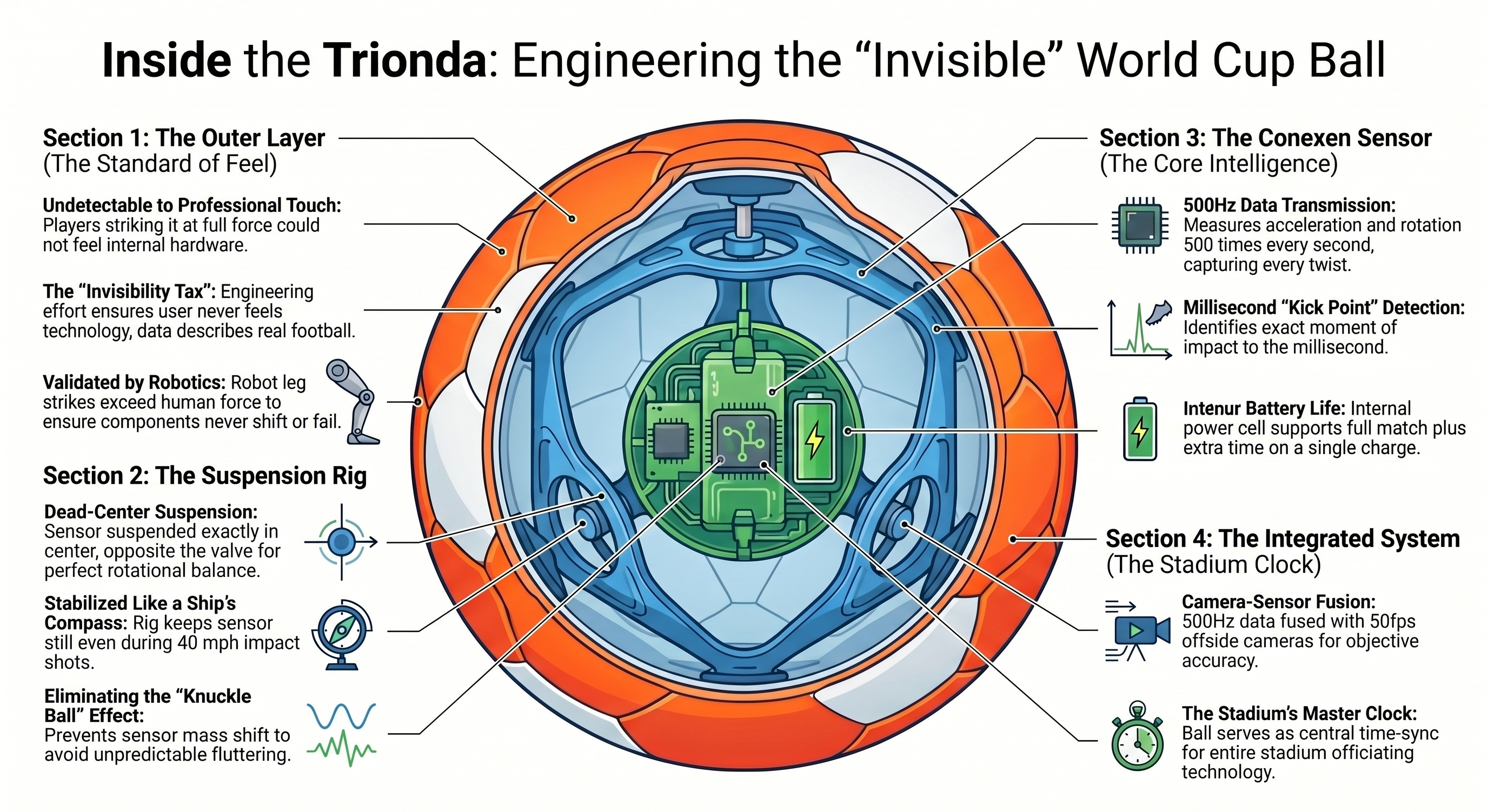 Download the one-page infographic
At the highest levels of professional sport, the human foot is a sensory organ of extreme precision. When Adidas recently invited elite players to test a new ball embedded with a high-speed computer, they were attempting a feat of high-fidelity deception. They dared these athletes—men and women whose careers are defined by the tactile feedback of a pressurized sphere—to find the ghost in the machine. The players struck the ball with maximum violence, and the result should stop any designer cold: they couldn't feel a thing. This is the central irony of modern engineering. The greatest achievement of the Adidas Triion ball is not the stream of data it emits, but its total commitment to being unnoticeable. In a world obsessed with more—more features, more presence, more noise—the Triion represents a masterclass in the discipline of disappearance.
The Paradox of Kinetic Transparency
In traditional product marketing, a company highlights its new hardware as the protagonist of the story. Yet, for the Triion, Adidas and the German firm Conexen have leaned into a counter-intuitive claim: " The ball does not affect performance whatsoever. "This is what we might call kinetic transparency. For a futurist, the fascinating element here is that the hardware’s success is measured by the user’s total ignorance of its existence. When you are instrumenting a sport built on physical intuition, you are operating in a domain where any deviation from the expected "feel" is a catastrophic failure. In this design environment, the win condition was absence. If the player senses the sensor, the product is finished.
The Secret Architecture of the Gimballed Sphere
The technical challenge of instrumenting a projectile is rooted in the chaos of mass. A sensor has weight, and mass inside a sphere is a volatile passenger. The moment that mass shifts—even by a fraction of a millimeter under the impact of a 40 mph shot—the ball’s balance is compromised. It becomes a "knuckle ball," a fluttering, unpredictable object that would be a scandal on the world stage. To solve this, Adidas developed a sophisticated internal suspension system. It holds the sensor at the dead center of the sphere, positioned directly opposite the valve to maintain a perfect center of gravity. Think of it as a ship’s compass on a gimbal; while the "sea" of a professional match heaves and strikes the ball, the internal needle—the sensor—cannot drift. This suspension rig, rather than the chip itself, is the actual product. It is the years-long R&D effort required to ensure that the technology remains weightless to the human touch.
Paying the Invisibility Tax
Every gram of technology added to a legacy object incurs an " Invisibility Tax. " This is the massive engineering debt paid specifically so the user never realizes the object has been altered. This tax is paid in the currencies of balance, battery life, and haptic transparency. To validate this, Adidas utilized a robot leg to strike the Triion thousands of times with a force exceeding human capability. This wasn't just a durability test; it was an audit of the tax. They had to ensure the six-hour battery and the internal rig could survive extreme violence while remaining silent. The first product that makes you feel the sensor it added is the day the invisibility tax comes due. The Triion avoids this day of reckoning by being so well-engineered that it feels like nothing at all.
The Ball as the Stadium’s Temporal Conductor
While the player feels nothing, the stadium’s digital architecture feels everything. The Triion serves as the master clock for the entire match. While the broadcast cameras capture video at 50 frames per second, the sensor inside the ball fires at 500 frames per second. When a foot makes contact, the sensor registers a massive data spike, identifying the "kick point" to the millisecond. This data is then fused with camera imagery to draw offside lines with a precision that was previously impossible. In this context, the ball has evolved from a simple piece of equipment into the conductor of the digital stadium, a high-frequency temporal anchor that syncs every other piece of technology in the arena.
The Sensor Decade and the Failure Mode of Presence
We are moving rapidly toward a "sensor decade" where instrumented gear—from boots to the pitch itself—will become the baseline floor of the industry within 18 months. However, this future holds a significant philosophical trap. If an athlete has to adapt their playstyle or their intuition to accommodate a sensor, the data collected is no longer a measurement of the sport. Instead, it is a measurement of an athlete reacting to technology. You haven't measured the game; you have changed it and then measured the change. To truly capture the essence of human performance, the technology must vanish into the gear. "The companies that win the sensor decade won't own the loudest chip. They'll own the one you forget is measuring you. "
The Discipline of Disappearance
The Adidas Triion is a testament to the fact that the best instrumentation disappears the moment you notice it measuring you. While the headlines may celebrate a ball that "talks" to cameras, the true engineering victory belongs to the players who swear it is just a ball. As we look at our own lives and the devices we carry, we must ask: which technologies have earned their place through disappearance, and which are merely loud? The future of product design may not lie in being more present, but in being so perfectly integrated that we forget it is there at all. Is our ultimate goal to build a world full of gadgets, or a world where the most advanced computers are the ones we can't even feel?