// The systems read, in writing
Why the Most Important AI Chip Just Left the Planet (And It’s Not for the View)
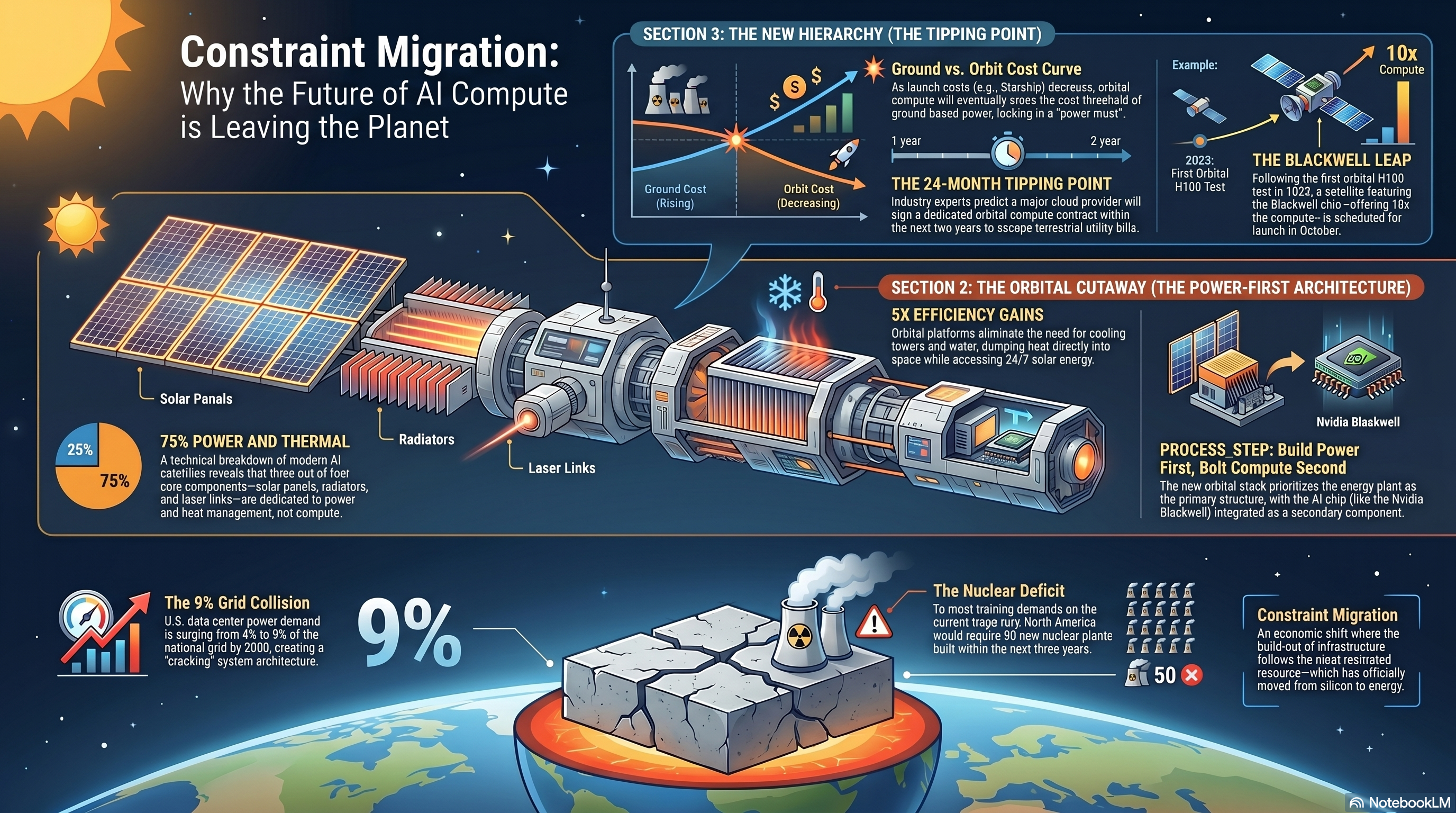 Download the one-page infographic
1. The Power Wall
The hidden crisis of Artificial Intelligence isn’t a lack of intelligence—it’s a lack of power. The assumption that we can simply plug the future of compute into our existing infrastructure is cracking. We are hitting a wall where the massive energy demands of training and running LLMs are beginning to break the terrestrial power grid. Last November, StarCloud quietly launched a working Nvidia H100 into orbit. It wasn’t a PR stunt; the chip trained a real model in the vacuum of space. While the world watched the launch as a feat of aerospace engineering, they missed the real story: the terrestrial power grid has become the primary bottleneck for the survival of AI. The move to orbit is a desperate, brilliant escape from a planet that can no longer keep the lights on for the models we’re building.
2. Takeaway 1: It’s an Energy Story, Not a Space Story
For 70 years, the architectural assumption of the computer age was simple: build compute near people and drag the power to it. That era is over. Compute is now migrating to where the energy is, regardless of where the users sit. In this new paradigm, satellites are being reimagined as "power plants that happen to hold a chip. "This is the "unbundling" of compute from the terrestrial grid. If you look at the hardware being sent up, the priorities of this new infrastructure are revealed in the spec:" Solar panels and radiators. A chip. Laser links. Three of the four are power and thermal, not compute. They're not building a faster chip... Orbit gives you sun all day, unlimited low-cost renewable energy. "We are witnessing a structural shift where the orbital layer becomes the primary site for heavy computation because it is the only place left with an uncapped power envelope.
3. Takeaway 2: The Brutal Math of the Terrestrial Grid
If you want to understand why the planet’s most advanced chips are heading for the stars, you have to read the physics of the ground. The math is brutal. In the United States, data centers are projected to jump from 4% of the grid to 9% by 2030. That sounds incremental until you look at the slope of the curve. To sustain the current trajectory of AI growth, North America would need to build 50 nuclear plants over the next three years just to power the models before they even begin training. Between the "interconnect queue" for new power projects that runs for years and the regulatory nightmare of permitting water-intensive cooling towers, the terrestrial grid has become a binding constraint. The bottleneck is no longer silicon; it is the watt.
4. Takeaway 3: The "Blackwell" Leap and the National Race
This isn’t a theoretical future; it is a deployment race that is scaling with terrifying speed. StarCloud’s H100 "bird" was just the proof of concept. The follow-up satellite, scheduled for launch this October, carries the Blackwell chip—delivering 10 times the compute of its predecessor. This isn't an isolated experiment. We are seeing three massive, simultaneous programs moving toward the same solution:
StarCloud: Rapidly iterating from H100 to Blackwell architectures.
SpaceX: Developing orbital data centers, backed by filings for up to a million satellites.
National Programs: A state-mandated national constellation that already has 12 satellites written into policy. The most telling detail? These three teams are using different stacks and have zero coordination. When three separate giants move toward the same radical solution at the same time, it isn’t a trend—it’s a structural necessity driven by the laws of physics.
5. Takeaway 4: Jevons Paradox and "Constraint Migration"
Economists recognized this pattern a century ago through Jevons Paradox : make a resource more efficient, and demand will expand to swallow the savings. In AI, we are seeing a " Constraints Migration. " The build always chases the bottleneck. Previously, the bottleneck was the availability of specialized silicon. As chip production scaled, the bottleneck migrated to energy. We are now seeing "computation moving up" to follow the energy, just as we previously saw "observation moving up" with imaging satellites. The infrastructure is chasing the only remaining unconstrained resource: 24-hour un-permited solar energy and the infinite heat sink of deep space.
6. Takeaway 5: The Orbital Economic Tipping Point
To be fair, we must acknowledge the current reality: StarCloud’s first satellite is "one fridge in low orbit," not a sprawling data center. Latency, radiation, and debris remain "minor logistics doing quiet work" in the background of these specs. However, the economic tipping point is closer than most realize. Orbital compute is already five times more efficient than terrestrial cooling because it dumps heat directly into space without the need for billions of gallons of water. The real crossover occurs when the cost of a Starship launch falls below the cost of building equivalent power and cooling infrastructure on the ground. "Once orbital compute locks in as the cheapest watts you can deploy... it compounds into a power moat nobody rebuilds on Earth. "Within 24 months, we expect a major cloud provider to sign an orbital compute contract. Once that moat is established, the competitive advantage will be insurmountable.
7. Conclusion: Choosing Your Layer
The fundamental strategic decision for any organization is no longer which chip to buy, but which layer your compute lives on. You can choose the ground, with its legacy grids, five-year permitting delays, and skyrocketing utility bills. Or you can choose the orbital layer, where the power plant is built first and the compute is bolted on second. As the infrastructure of intelligence migrates upward, the question is simple: Are you willing to pay a terrestrial power bill that your competitors have already left the planet to escape?