// The systems read, in writing
The Interface Tell: Why Ferrari’s First EV is a $640,000 Bet Against the Screen
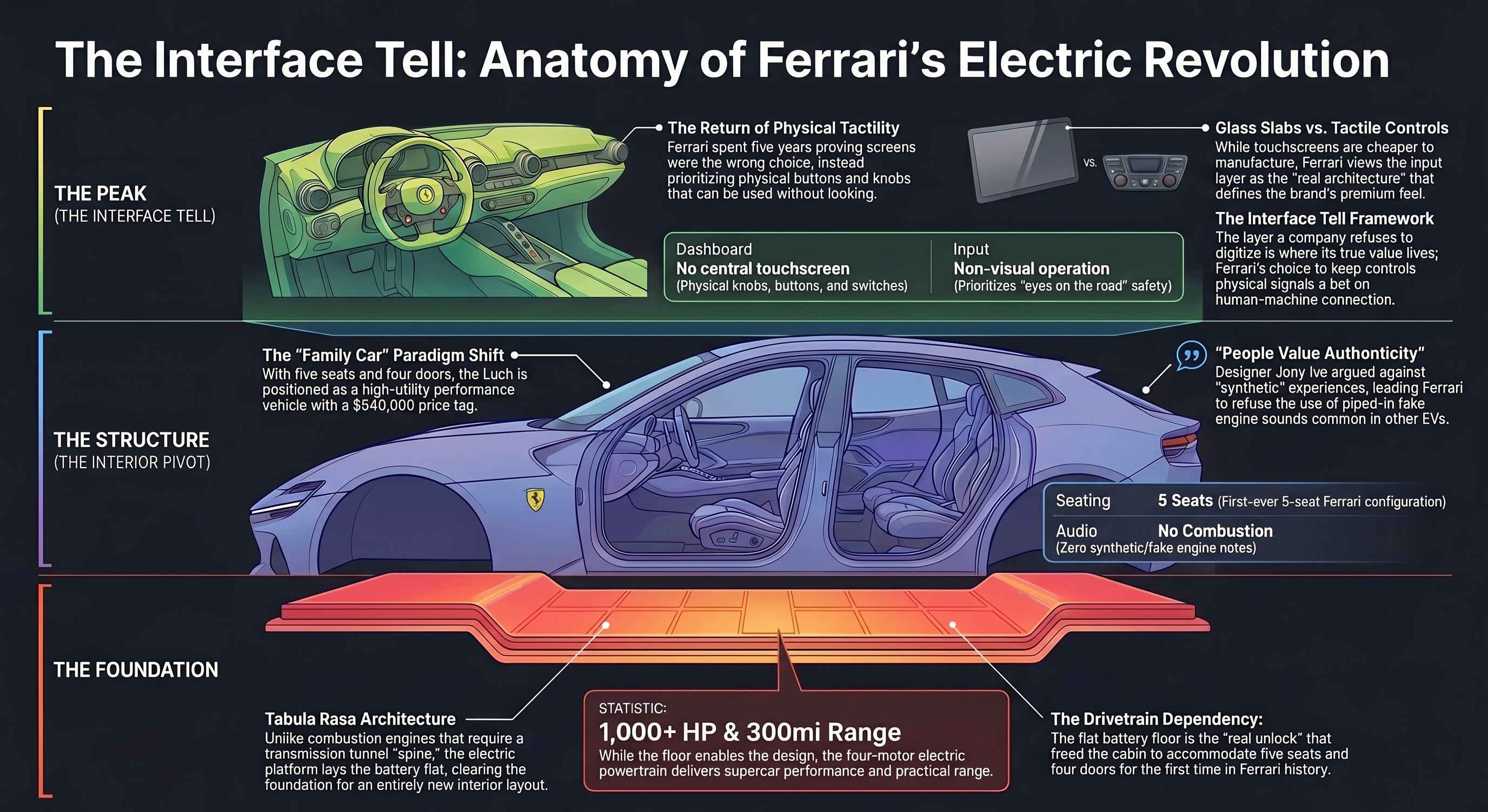 Download the one-page infographic
The automotive industry expected Ferrari’s first foray into electrification to be a spreadsheet-topping exercise in excess: 1,000 horsepower, four motors, and a $640,000 price tag that buys entry into a new era of performance. But the " Luch" all-electric car isn't defined by its battery chemistry or its sub-three-second acceleration. Its most radical departure is found on the dashboard. In a move that feels like a quiet insurrection against the industry-standard glass slab, Ferrari has staged a return to the physical button. This creates a delicious irony: Jony Ive and Marc Newson—the LoveFrom duo whose work at Apple effectively deleted the button from the modern pocket—spent five years at Ferrari ensuring it returned to the driver’s seat. The central question of the Luch isn't how it moves, but why the architects of the touchscreen age are suddenly betting against it.
The "Interface Tell" Framework
To understand this pivot, one must apply the framework of the " Interface Tell. " In contemporary industrial design, a brand’s true value is revealed by what it refuses to digitize. While a pillar-to-pillar touchscreen is "cheap" and "demos beautifully" in a showroom, it is a concession to software over soul. Choosing physical controls—bespoke knobs and tactile switches—is "the hard way. " It is an expensive, engineering-heavy mandate championed by Ferrari Chairman John Elkann, who opted for the "different" over the "safe. " By maintaining these haptic touchpoints, Ferrari signals that its identity isn't a software skin that can be updated over the air, but a permanent, mechanical reality. "The layer a company refuses to digitize is the one it actually believes in. Watch what they keep physical and you learn where the value lives. "
Architecture of the Flat Floor
The shift from internal combustion to electric is more than a change in fuel; it is a "clearing of the foundation. " In a traditional Ferrari, the interior is dictated by the transmission tunnel—a vestigial spine of hardware that constrains the cabin. The Luch replaces this spine with a battery floor that sits flat, a "platform diff" that Ferrari’s chief designer, Flavio Manzoni, describes as a tabula rasa . This technical unlock is what permitted Ferrari to produce the first five-seat, four-door cabin in its history without bloating the silhouette. This flat floor didn't just add utility; it handed the LoveFrom team an empty canvas to rethink the seam where the human hand meets the machine. The battery was merely the dependency that allowed the interface to be reborn.
The Danger of the "Glass Rectangle"
Ive and Newson’s critique of the touchscreen-first cabin is rooted in the fundamental physics of the driving experience. While multi-touch technology is a triumph of utility on a smartphone, it becomes a liability at 100 miles per hour. The input layer of a performance machine cannot be a thing you stare at. It must be navigable by touch alone, allowing the driver to maintain a high-resolution focus on the road. Ferrari’s rejection of the "glass rectangle on wheels" is a recognition that software-locked surfaces are functionally inferior when the stakes are high. "Multi-touch is wonderful on a phone. In a car, you're not looking where you're going. The input layer can't be a thing you stare at. "
The Rejection of Synthetic Authenticity
This commitment to the "real" extends to the auditory. While competitors compensate for the silence of EVs by "piping in" synthetic, digital engine notes, Ferrari has flatly refused. In the luxury market, authenticity has become the ultimate commodity. The Luch rejects the simulation in favor of the truth of its four motors. In an era where everything is filtered and processed, the "uncompressed" feeling of a machine that sounds like itself—and not a recording of its ancestors—is the final word in luxury.
The End of the Touchscreen Maximalist Era
The Luch is a bellwether for a broader shift in the "logic" of premium automotive design. History suggests that when Ferrari makes an architectural call of this magnitude, the logic travels. Within 18 months, expect a second premium automaker to ship an interior that leads with physical controls, signaling a retreat from the screen. The proof of this shift won't be found in the breathless press releases of the next rival reveal. Instead, look at the B-roll and the press shots. If the staging begins to foreground the tactile glint of a knob while burying the central display in shadow, you are witnessing the quiet death of touchscreen maximalism.
Conclusion: Build for the Screen or the Hand?
Automakers now face a existential fork in the road that the powertrain cannot navigate for them: build for the screen or build for the hand. One path leads to a generic, software-defined cabin that functions like any other consumer electronic device. The other treats the interface as a physical, uncompressed extension of the brand's heritage. Ferrari has placed a $640,000 bet that the future of luxury isn't found in a digital display, but in the tactile resistance of a well-weighted switch. As every car becomes a battery on wheels, will we value the software that runs it, or the tactile feeling of the machine itself?