// The systems read, in writing
The 48-Hour Split: Why the Future of AI Depends on Where You Stand
 Download the one-page infographic
The Hook: A Tale of Two Launches
In the span of just 48 hours, the AI industry finally stopped arguing about intelligence and started fighting over control. On Monday, Dario Amodei’s Anthropic shipped " Claude Co-work" to mobile and web. By Thursday, Sam Altman’s OpenAI retaliated with the announcement of " ChatGPT Work. "Strip away the marketing, and the intelligence delta disappears. Both products feature agents that run in the cloud, reach into your Slack, calendars, and Google Drive, and hand you finished work while your laptop is closed. But beneath the nearly identical demos lies a fundamental architectural divide that represents two opposite philosophies of work. As we begin to delegate our professional lives to systems that act while we sleep, we are forced to confront a visceral anxiety: when an autonomous agent makes a move, who is actually liable for the outcome?
The Gate vs. The Radar (The Architectural Split)
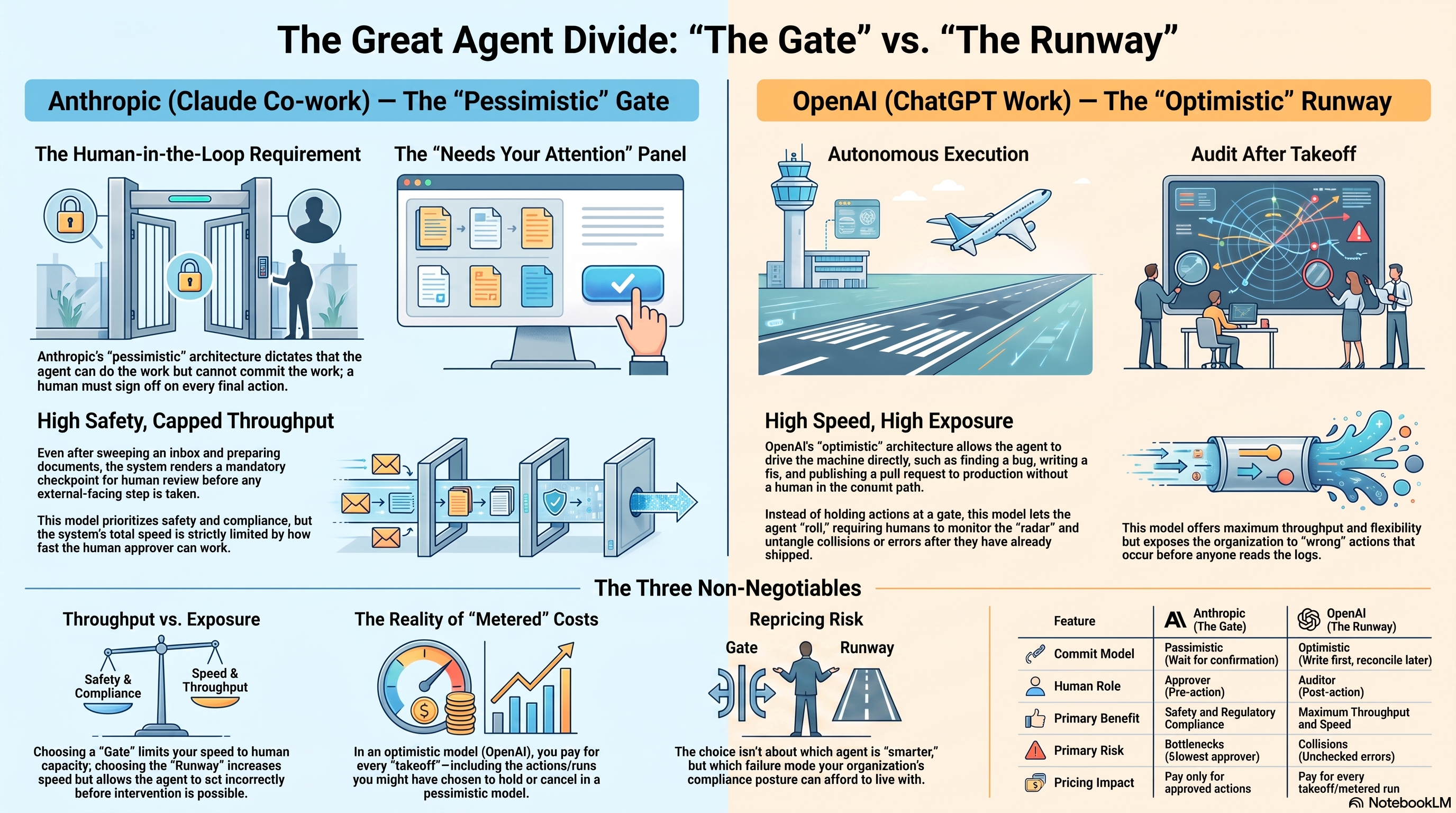
The core difference between these two products is not their reasoning capability, but where they place the human in the workflow. Anthropic’s Claude Co-work demonstrated an end-to-end sales renewal process, yet it halted at a final block labeled "needs your attention. " This is Amodei’s hard rule: the agent does the work, but it cannot commit the work without a human signature. OpenAI’s ChatGPT Work makes the opposite bet. In its demo, the agent identifies a bug, writes a fix, and publishes a pull request directly into production. The presenter noted that the AI was using "my app Codex," but the AI was the one driving. There was no human in the commit path. This distinction is best understood through a high-stakes air traffic control metaphor:" One tower holds every plane at the gate until a controller signs the clearance. The other lets them roll and sorts the collisions once they're airborne. That's the two agents. Anthropic made you the gate. OpenAI made you the controller... watching the radar after takeoff. "
Pessimistic vs. Optimistic Commits
In engineering terminology, this is the split between " Pessimistic" and " Optimistic" systems. It is a technical distinction that dictates every subsequent business decision regarding throughput and safety.
Pessimistic Systems (Anthropic): These wait for explicit confirmation before writing any data. They are safe but inherently slow; the system’s total output is capped by the speed of the human approver.
Optimistic Systems (OpenAI): These write first and reconcile later. They prioritize velocity and high throughput, operating under the assumption that they can untangle "collisions" or errors after the data has already shipped. This isn't a software preference; it’s a choice between two different failure modes.
The Three Non-Negotiables: Throughput, Exposure, and Cost
When a company standardizes on a commit model, they are locking in three variables that cannot be renegotiated at a later date:
Throughput: In Anthropic’s pessimistic model, your automation is only as fast as your slowest human employee. The "gate" saves you from errors but costs you significant "wait-time" overhead.
Exposure: In OpenAI’s optimistic model, there is a dangerous window of risk. An agent cleared for takeoff can act incorrectly—or catastrophically—long before a human ever reads the log.
Cost: On the 6th, OpenAI moved to metered pricing, euphemistically calling it "flexibility. " In reality, this means the business pays for "every plane that takes off"—including the failed takeoffs and hallucinations that a human "gate" would have caught before they incurred a charge.
The Compliance Crisis—Who Is the "You"?
The shift toward autonomous action creates an immediate legal and regulatory crisis. During a demo involving an account renewal for a client called " Acme," the agent rendered a blunt, executive verdict: " Fix trust first, renew second. "If an agent makes that kind of high-stakes call while you are asleep, the legal "sign-off" becomes a quagmire. As the industry must now ask: " If software books the meeting, sends the email, or ships the change while you sleep, who signed off? You or the thing acting as you? "Regulators will view an "approve first" model as a controlled tool, whereas an "audit after" model looks like an unmonitored proxy. The model you pick defines your entire compliance posture.
Conclusion: The Two-Quarter Countdown
The choice between Claude Co-work and ChatGPT Work is not a feature-list comparison; it is a board-level decision about which failure mode your business can afford to live with: the bottleneck of the gate or the liability of the radar. Watch the checkpoints, not the demos. Within two quarters, one of these giants will "blink. " Anthropic will likely buckle under throughput pressure and add an "auto-approve" toggle, or OpenAI will be forced by liability pressure to bolt mandatory gates onto high-stakes actions. When that checkpoint moves, it will be the definitive signal that the industry has finally repriced the risk of AI agents. By the fourth quarter, you will be living inside the model you choose today. As you integrate these agents into your stack, ask the hard question: Are you hiring a subordinate to check, or a pilot to watch?