// The systems read, in writing
The Map is the Ceiling: Why the Future of Autonomy Isn’t Where You Think It Is
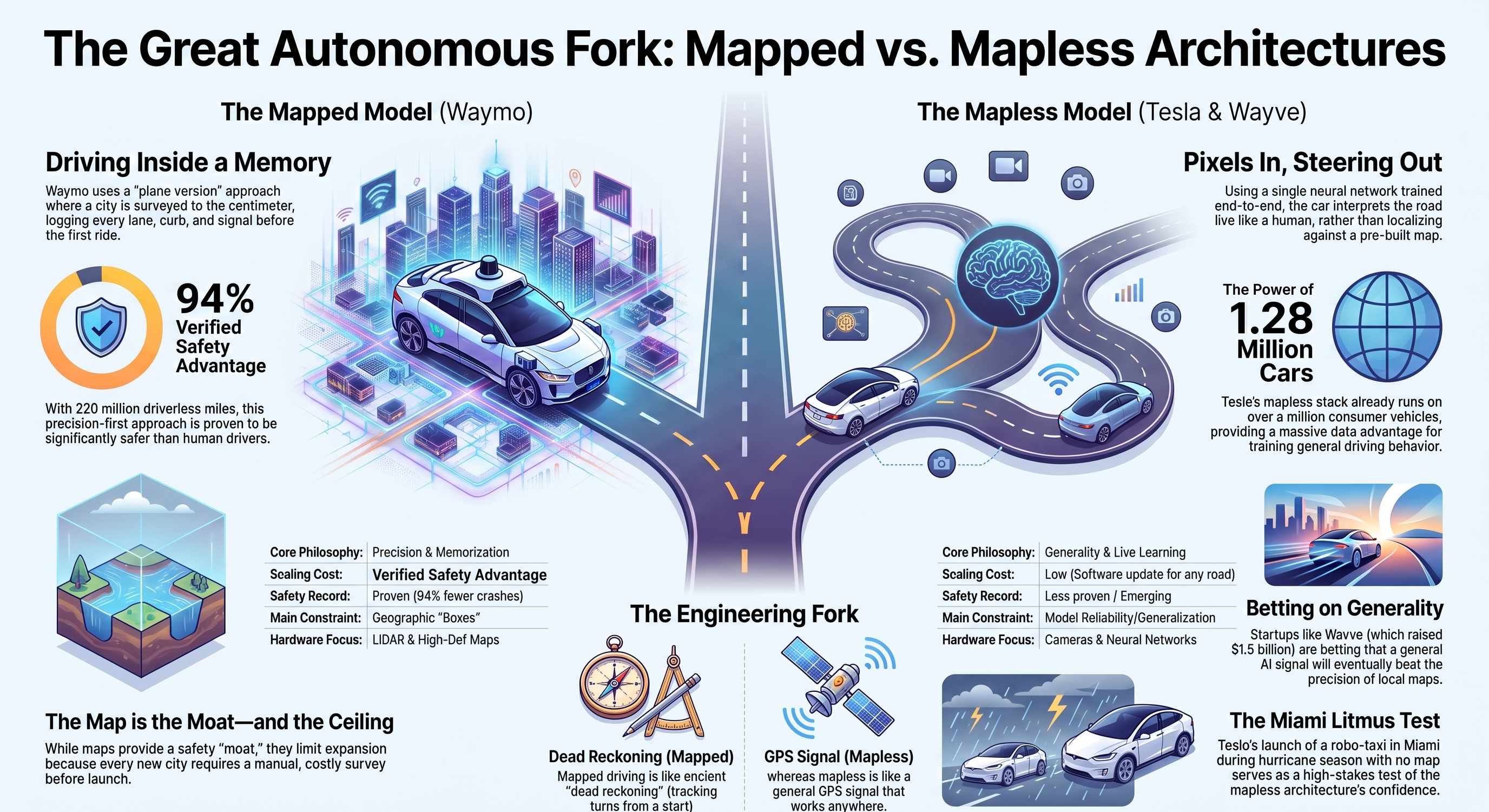 Download the one-page infographic
The Intersection at 8th and Ocean: Architecture on Trial
On July 3rd, the streets of Miami became the staging ground for a fundamental collision of philosophies. Tesla flipped the switch on its robo-taxi service, deploying vehicles with no safety driver, no remote monitor, and—most importantly—no asterisk. By launching directly alongside Waymo’s established fleet, Tesla didn’t just start a price war; it put a specific AI architecture on trial. While most observers are busy counting miles or neighborhoods, they are missing the engine room. These are two fundamentally different species of machine. One drives via memory, the other via sight. This isn’t a race to see who can plant a flag in more cities; it is a fork in the road for the very nature of artificial intelligence.
The Cartographic Cage
Waymo has built what is essentially a "mapped" car—a machine that memorizes the world before it dares to navigate it. Before a Waymo vehicle ever turns a corner in a new zip code, a specialized crew must survey every lane, curb, and signal to the centimeter. This is the high-definition map: a digital straightjacket that ensures safety but demands total obedience. The technical mechanism here is localization. Waymo’s LiDAR sensors are constantly matching what they see in real-time against what the survey recorded. It isn't "figuring out" the road; it is localizing itself inside its own memory. This approach has produced a staggering 220 million driverless miles and a safety record featuring 94% fewer serious injury crashes than human drivers. It is a certifiable product, but it is also one that breaks on the rocks of economics. "The map is the moat and the map is the ceiling. "The very thing that provides Waymo’s safety moat—the exhaustive upfront survey—is the ceiling that prevents it from scaling. Every expansion moves the wall further out, but the wall remains. The mapped approach is a rational bet for today’s regulators, but it is a "sharp but boxed" solution that requires a massive upfront investment for every new square mile.
"Pixels In, Steering Out": The Neural Network Bet
Tesla has bet the house on the opposite architecture: a mapless, end-to-end neural network. There is no pre-built survey to localize against. Instead, the system uses cameras to interpret the road live, mimicking human cognition. It is a "pixels in, steering out" model that processes the world as it happens. The confidence required to release this stack in Miami during hurricane season cannot be overstated. Tesla isn't just testing a demo; they are leveraging a massive data advantage. This same software stack is already running on 1.28 million consumer cars, creating a feedback loop that no survey crew can match. While it remains less proven on the street than the mapped model, it avoids the scaling wall entirely. In theory, it can navigate any road it has never seen because it isn't trying to remember—it is trying to think.
The Great AI Fork: Curated Knowledge vs. General Learning
This isn't just a debate about steering wheels; it is the central fork under every AI system in development today. Developers are being forced to choose: Do you curate the knowledge upfront to ensure precision, or do you let the model learn general behaviors and bet that generality eventually beats curation? This single decision sets everything downstream—from the cost to enter a market to the speed of global scale. The trade-offs are stark:
Mapped/Curated: Precision, safety certification that regulators can easily read, but a crushing economic cost per city.
Mapless/Learned: Generality, the ability to scale rapidly across the "open world," but a lack of traditional "if-then" safety guarantees.
Dead Reckoning vs. the New GPS
To understand why the mapped approach is currently hitting a ceiling, look to maritime history. For centuries, ships relied on "dead reckoning"—tracking every turn and mile from a known starting point. It was precise at first but, by its very nature, drifted from the truth with every passing mile. It was only when a general signal arrived—GPS—that sailors could know exactly where they were anywhere on Earth. The mapped approach is modern dead reckoning: it is exact within its pre-defined zone but remains boxed by it. The model-based approach bets that a general signal, capable of navigating the "open world" without a script, is the only way to win the long game.
The $1.5 Billion Endorsement
If you think mapless autonomy is a fringe experiment or a one-company obsession, look at the capital. Wayve, a London-based AI firm, recently raised $1.5 billion to develop its own end-to-end, mapless architecture. This isn't speculative venture capital; it is backed by industry giants like Stellantis, Uber, and Nissan. When the companies that actually build and deploy the world's fleets sign on, the mapless model is no longer a "fringe" bet—it is being funded like a winner.
Conclusion: The Signal to Watch
The architecture tells the story that the headlines haven't caught up to yet. Within three years, the mapped approach will not "lose," but it will be cornered. It will remain the safest, most reliable ride in the specific "boxes" it has already surveyed, but it will be a prisoner of its own geography. The real signal that the curve has changed shape won't be a PR stunt or a new city launch. Watch for the day a mapless car opens a hard, unmapped city as a paying route , not a demo. That is the moment the general signal proves its dominance over the curated map. As we watch this play out, we have to ask ourselves: In a world of infinite complexity, do we prefer an AI that follows a perfect script, or one that has finally learned how to think on its feet?