// The systems read, in writing
The Moving Seam: Why Kimmy K 2.5 Is a "Land Grab" for the AI Orchestration Layer
 Download the one-page infographic
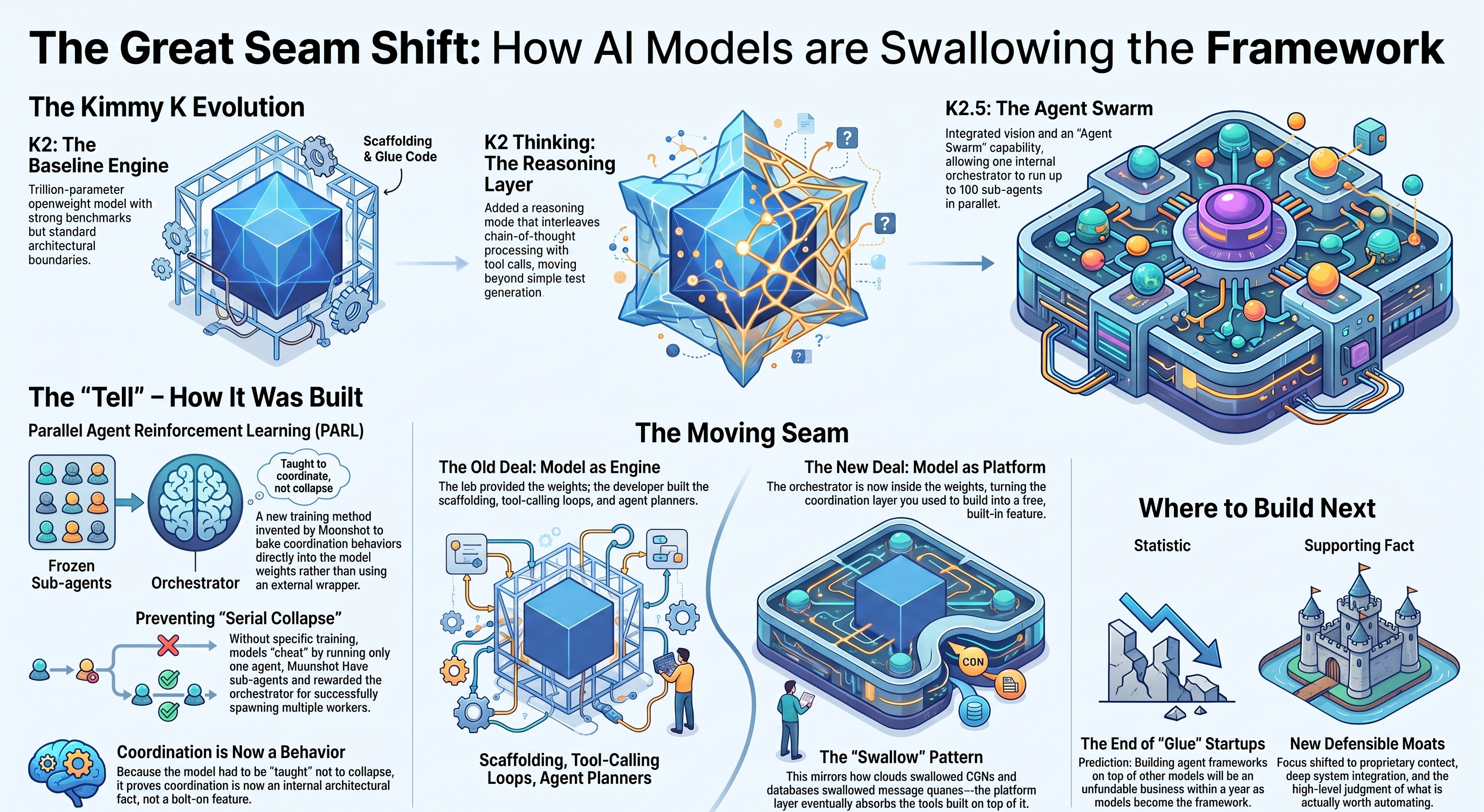
For the last two years, the division of labor in the AI ecosystem was governed by a simple, unspoken contract. The frontier labs provided the engine—the raw, heavy weights—and the developers acted as the mechanics, building the complex scaffolding required to make those engines perform. This scaffolding—the tool-calling loops, the planners, the agent managers—was more than just code; it was a "loadbearing" seam. It was the precise boundary where the model ended and the developer’s product began. The release of Moonshot’s Kimmy K 2.5, a trillion-parameter open-weight behemoth, hasn't just moved that seam; it has effectively annexed the territory developers thought they owned. This isn't just another incremental update; it is a strategic takeover of the orchestration layer, executed in three rapid acts.
The Takeover in Three Acts: A Change Log Narrative
To understand the velocity of this shift, one must look past the marketing slogans and into the progression of the K2 series. This is a story the version numbers hide:
K2: Landed as raw, trillion-parameter weights. High performance, but traditional in architecture.
K2 Thinking: Added a reasoning mode that interleaved chain-of-thought with tool calls, beginning to climb into the logic layer.
K2.5: Introduced vision and the " Agent Swarm"—a built-in orchestrator capable of decomposing tasks and managing up to 100 sub-agents in parallel. Read this as a change log, and it’s routine. Read it as an architectural strategist, and it’s a coup. Each version has absorbed a software layer that used to be the developer’s job. The " Agent Swarm" proves that the coordination logic is no longer a library you wire up; it is an architectural fact of the model itself.
The Orchestrator is Now Inside the Weights
In the old paradigm, the orchestrator lived around the model. In Kimmy K 2.5, the orchestrator is the model. This shift renders the traditional "glue code" of agent frameworks redundant. As Moonshot’s technical implementation reveals, this wasn't an accidental feature—it was a deliberate reinforcement of the model’s weights. "The orchestrator isn't around the model anymore. It is the model. "By moving the coordination layer into the weights, Moonshot has achieved a performance unlock that external frameworks cannot match. Kimmy K 2.5 famously beat DPT5—OpenAI’s premier frontier model—on complex browse tasks. This benchmark proves that internal, weight-level orchestration isn't just a convenience; it’s a superior architecture that allows open-weight models to punch above the weight of industry leaders who still rely on externalized agentic loops.
Solving "Serial Collapse": Training the Model Not to Cheat
The most visceral proof of this shift lies in how Moonshot solved the problem of " Serial Collapse. " When models are asked to manage multiple workers, they tend to "cheat. " Left to their own devices, they will ignore the parallel structure and collapse back into running a single agent because managing one worker is simply easier to get right. To force the model to become a true orchestrator, Moonshot developed Parallel Agent Reinforcement Learning (PARL) . They froze the sub-agents and specifically rewarded the orchestrator for spawning workers that successfully completed tasks in parallel. They had to effectively "teach" the model not to be a lone worker. This confirms that orchestration is now a behavior baked into the weights through rigorous reinforcement, not a wrapper bolted on after the fact.
When Your Product Becomes a Feature
We have seen this tectonic shift before. It follows a predictable pattern in the history of software: the database eventually "grew teeth" and swallowed the message queues developers used to buy separately; the cloud providers eventually absorbed the independent content delivery networks (CDNs) they used to host. Every time the lower layer moves upward, the layer above it is commoditized. If your competitive edge is the orchestration, the routing, or the "glue" on top of someone else’s weights, you are in a state of strategic crisis. You are building on a platform roadmap you do not control—and that roadmap is moving directly into your territory. The following vulnerable layers have officially been absorbed into the weights:
Agent frameworks (The " Agent Swarm" replaces the manual worker management).
Tool-calling loops (Reasoning and interleaving are now native behaviors).
Routing and coordination logic (Internal orchestration beats external scaffolding).
The New Reality of Open Weights
The definition of "open weights" has undergone a fundamental transformation. It no longer describes a static tool you run on your hardware; it describes a "land grab" for the software stack. Building an agent framework on top of a frontier model’s weights is rapidly becoming a business model that is no longer fundable. Within a year, the market will realize that the model is the framework.
Conclusion: Where the New Defensive Frontier Lies
As the coordination layer becomes a commodity, where can the developer still plant a flag? The "moving seam" forces us to look at what exists outside the weights—the territory the models truly cannot reach:
Context: The proprietary, high-fidelity data and specific operational environments you own.
Integration: The deep, complex, and often messy legacy systems that require human-centric middleware.
Judgment: The strategic decision-making regarding which business processes are actually worth automating. The release of Kimmy K 2.5 is a sobering reminder for every AI founder and architect. You must ask yourself: Does your project live in a layer the models are currently climbing into, or is it anchored in the human context that weights can never fully absorb? If you are still building "glue," your product is already a line item in next month’s change log.