// The systems read, in writing
The Trillion-Dollar Door: Why Roche Stopped Reinvesting in Drugs and Started Hacking the Brain’s Security System
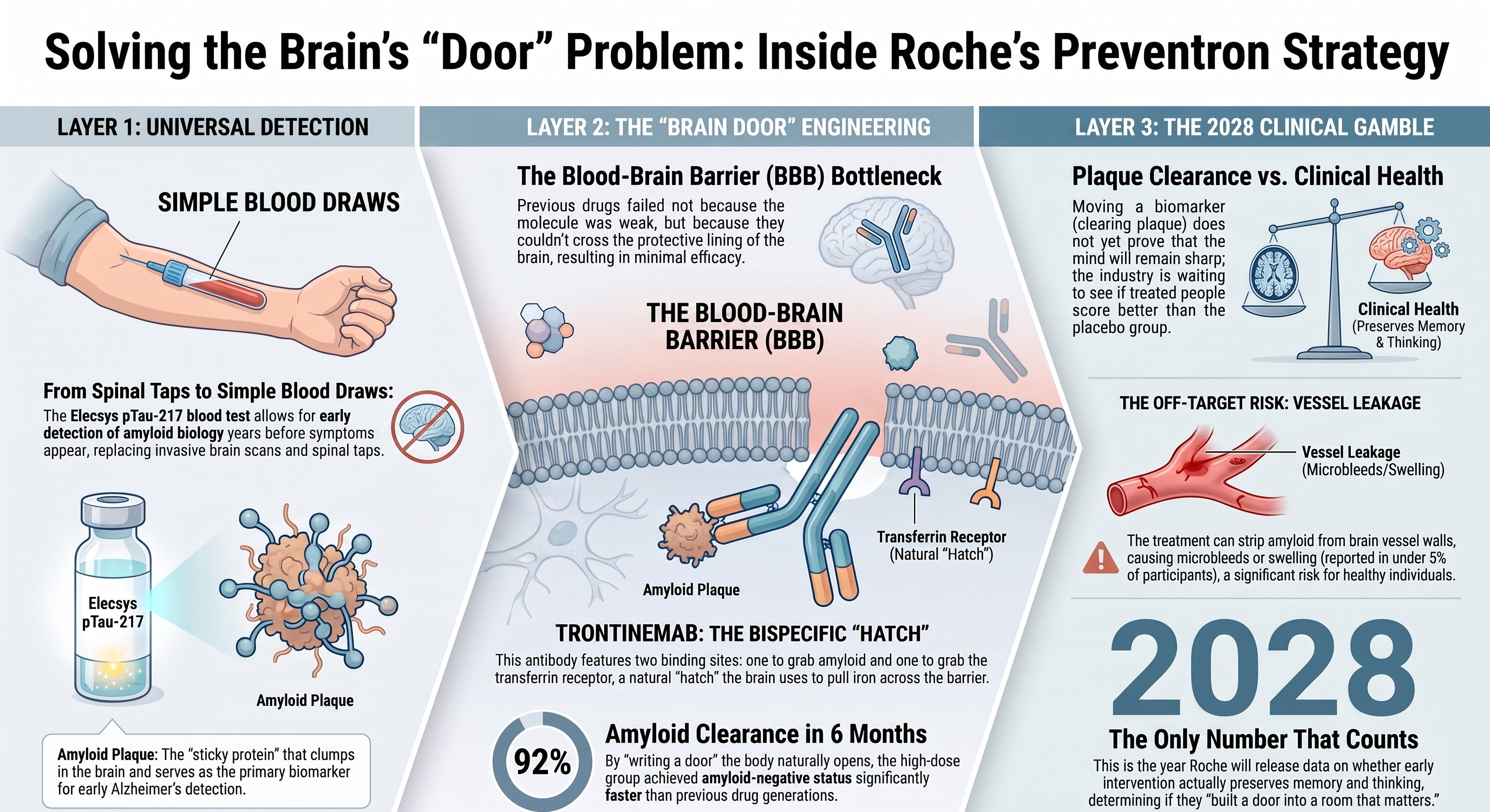 Download the one-page infographic
1. The Door Problem
Imagine holding the perfect key to a vault, only to realize you can’t even find the door. For decades, the war on Alzheimer’s has been a multi-billion-dollar hunt for the perfect "key"—a molecule capable of clearing the toxic amyloid plaques that rot the human mind. But here is the tell: Roche’s recent high-profile failures weren't actually failures of medicine. The molecules worked perfectly; they just couldn't get into the room. The obstacle is the Blood-Brain Barrier, a biological security system so tight it effectively locked the cure out. Roche has finally stopped trying to build a heavier payload. Instead, they’ve pivoted to a far more sophisticated engineering challenge: they are building a better transport system.
2. The 2% Failure: Why Great Drugs Frequently Fail
The data reveals a staggering, almost tragic, inefficiency in traditional Alzheimer’s treatment. In standard doses, barely 1% to 2% of the medicine ever actually reaches the brain. This is the great "seam" in medical history: it is entirely possible that we have possessed the cure for years, but we were simply too clumsy to deliver it. The Blood-Brain Barrier (BBB) is a protective lining designed to keep large molecules out of the central nervous system. While it’s an evolutionary masterstroke for keeping out toxins, it is a disaster for modern pharmacology. We have been effectively rewriting the code for years when the network was the problem. These large-molecule antibodies cleared plaque in a Petri dish with ease, but in a living patient, they simply broke against the wall.
3. Hacking the Iron Hatch: The Rise of Bispecific Antibodies
To solve this, Roche developed " Trinamab," a bispecific antibody that functions as a sophisticated "brain shuttle. " Unlike traditional antibodies, Trinamab has two binding sites. One site is the weapon, designed to grab the amyloid plaque. The other site is the "hack"—it grabs onto the transferrin receptor, a biological hatch the brain already opens to pull iron across the barrier. "They didn't force a stronger drug through. They wrote a door the body opens anyway. "By hitching a ride on the body's own metabolic hunger for iron, Trinamab sneaks across the barrier like a Trojan Horse. The results of this engineering shift are undeniable. In vivo testing showed that 92% of the high-dose group hit "amyloid negative" status in just six months. Where previous drugs stalled out and drifted, this new delivery mechanism moves with terrifying speed.
4. From Spinal Taps to Physicals: The Democratization of Detection
Solving the delivery problem only matters if you know whose door to knock on. For years, detecting Alzheimer’s early required a specialist referral for an invasive spinal tap or a prohibitively expensive PET scan. This created a bottleneck that kept the disease in the shadows until it was too late to treat. That bottleneck is dissolving. Roche’s " Elecsys pTau217" blood test recently cleared approval in Europe, allowing a simple blood draw to flag amyloid formation years before the first flare of memory loss. This shifts the entire landscape: Alzheimer’s detection is moving from a specialized crisis to a routine check-up, much like a cholesterol test. However, this new ability to see the disease coming years in advance necessitates a "working door" into the brain; you cannot wait for the barrier to break down on its own if you intend to treat the "pre-patient. "
5. The "Empty Room" Paradox: Biology vs. Cognition
Roche is now betting everything on its " Preventron" Phase 3 trial. The design is audacious: it recruits people who feel completely fine but carry the early biological markers of the disease. The goal is to clear the biology now to see if they stay well later. But as we move treatment upstream to healthy people, the math flips. The risk-reward calculation changes when the patient isn't yet suffering. Trinamab has "off-target effects" where the antibody strips amyloid off the walls of tiny brain blood vessels. When that plaque lifts, the vessels can leak, causing microbleeds or brain swelling. The stakes of this "math flip" are literal. One participant with a pre-existing blood vessel condition died from a brain bleed during testing, forcing Roche to tighten its inclusion criteria. While Roche reports these incidents in under 5% of participants, the question for a healthy person remains: are you willing to accept a real brain risk today to dodge a "maybe" disease decades from now?
6. 2028: The Year Medicine Changes (Or Doesn’t)
The medical community has circled 2028 on the calendar. That is when we will find out if clearing the biology actually saves the mind. We already know the drug can clear the plaque; the real test is whether the treated group scores sharper on thinking and memory than the placebo group. If the gap is real, we have birthed a new category of preventative medicine. If it isn't, then Roche has simply built an incredibly elegant door into an empty room. We are entering an era where we can treat potential diseases before they manifest, but we must face the chilling possibility that clearing the biology might not be enough. If the mind doesn't hold even after the plaque is gone, we will have to ask what happens when the engineering is perfect, but the room is already lost.