// The systems read, in writing
The Deletion Gambit: How BYD Used a "Weaker" Battery to Break the EV Architecture
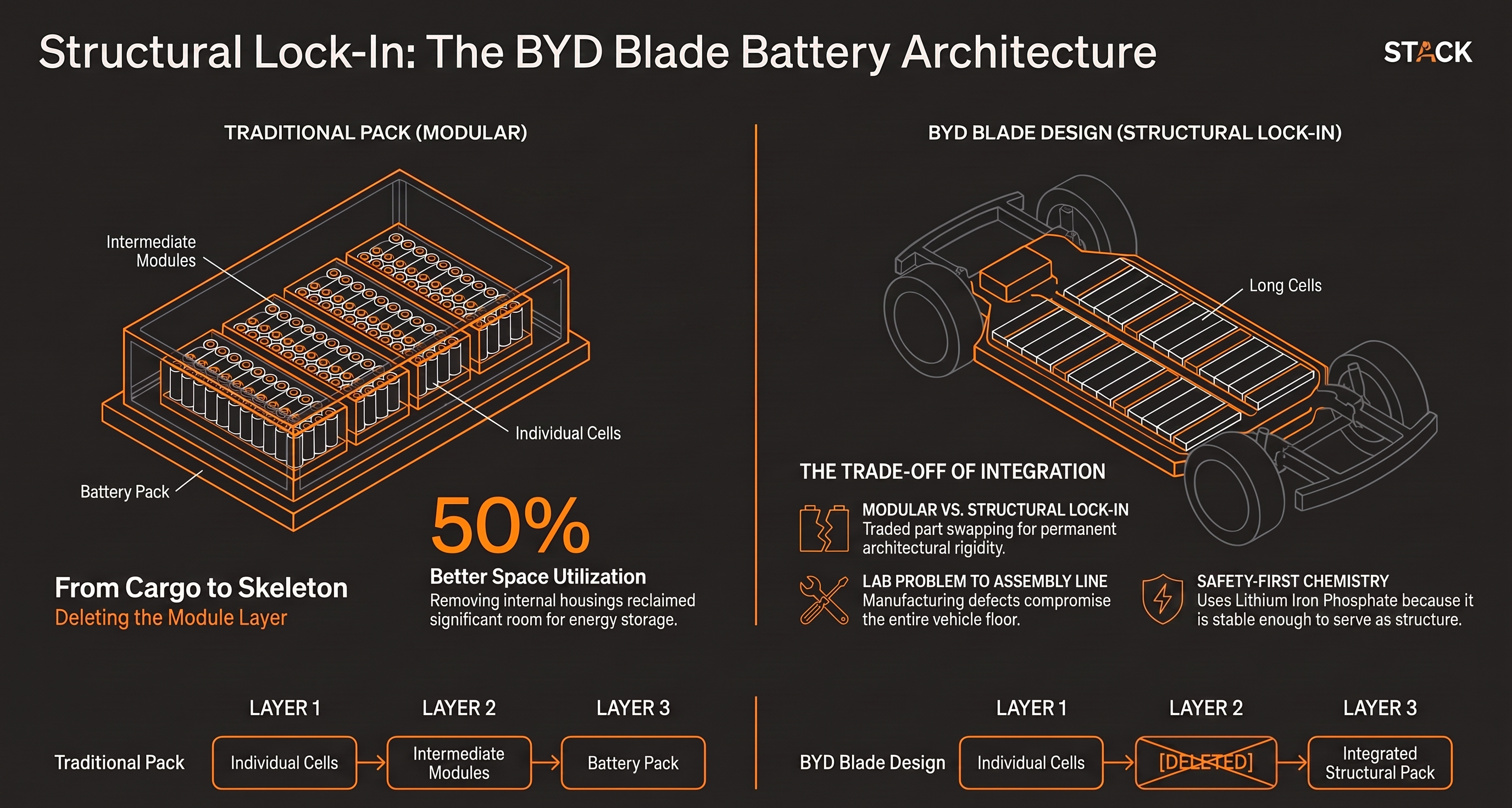 Download the one-page infographic
Introduction: The Ghost in the Machine
In the high-stakes theater of global electric vehicle production, BYD—ironically an acronym for " Build Your Dreams"—operates with a cold, structural pragmatism that many Western rivals missed. BYD is not a car company that builds batteries; it is a battery company that happens to build cars. Having manufactured cells for eight years before its first vehicle ever rolled off the line in 2003, BYD views the battery pack not as an outsourced component, but as the foundational architecture of the machine. While the rest of the industry spent the last decade hunting for a "holy grail" chemical breakthrough, BYD executed a radical disruption three layers deep in the assembly process. There was no flashy keynote slide for this shift. Instead, BYD embraced a "weaker" chemistry to solve a much harder structural problem, ultimately proving that how you package power is just as important as how you generate it.
Takeaway 1: Solving the Wrong Problem (Chemistry vs. Packaging)
The industry-wide obsession has long been the "lab battle"—the pursuit of higher energy density through complex nickel-based chemistries. BYD chose to exit this race. They doubled down on Lithium Iron Phosphate (LFP), a chemistry widely dismissed as the "budget option. " On paper, LFP is the weaker cell: it is older, cheaper, and objectively worse at storing energy per kilogram. However, BYD’s strategy was to stop fighting the chemistry and start fighting the architecture. They "accepted the worst number" of LFP—its lower density—in exchange for its superior thermal safety. Since LFP doesn't burn with the same volatility as high-density rivals, BYD realized they could stop over-engineering the safety housings and start reclaiming the physical space those housings occupied. They moved the challenge from the lab to the packaging layer.
Takeaway 2: The Power of Deletion (The 50% Space Win)
Conventional EV battery architecture is a study in redundant architecture, nesting components like a set of measuring cups. Traditionally, the design requires four distinct, heavy layers: the Cell, the Module, the Pack, and finally, the Vehicle. Each tier demands its own housing, cooling lines, and bracing. In March 2020, with the launch of the Han sedan, BYD executed the " Power of Deletion. " They removed the " Module" tier entirely. By laying long, thin cells directly into the pack, they eliminated the physical housings and redundant bracing required by that middle layer. The resulting "50% better space use" is a figure that has been echoed throughout the industry, but it requires an analyst’s eye to interpret. This was not a breakthrough in energy storage; it was a victory over wasted room. "The 50% space win is a structural claim measured against a design carrying four sets of housings, not a breakthrough in storing energy. It is simply the room a nested design previously wasted. "
Takeaway 3: The Bird Skeleton Metaphor (Battery as Frame)
To understand why this move is so disruptive, one must look at avian biology. A bird’s bones are hollow, which is often misinterpreted as a pursuit of lightness. The real "trick" is that the bone walls carry the structural load while the interior performs a second job. One structure, two duties. BYD applied this "double duty" principle to the Blade Battery. By laying long, flat cells edge-to-edge, the battery pack achieves a level of stiffness sufficient to brace the vehicle itself. The battery is no longer "freight"—passive cargo that the car is forced to carry—it is the "skeleton. " This shift turns the battery from a swappable part into a "structural dependency. " The pack stops being a component and becomes the frame.
Takeaway 4: The Hidden Cost of "Structural Lock-in"
This leap in efficiency is not a free lunch; it is a calculated gamble that creates a " Structural Lock-in" which many OEMs would find terrifying. By making the battery a load-bearing member of the chassis, BYD sacrificed three critical forms of optionality:
Repairability: You cannot simply swap a bad module under warranty. When the battery is the floor, a single cell failure becomes a major structural intervention.
Portability: These packs are not standalone parts that can be easily sold to other manufacturers; they are integral to the specific vehicle’s rigidity.
Flexibility: This move freezes the design. The moment a component becomes load-bearing, everything upstream (cell design) is locked, and everything downstream (chassis manufacturing) inherits its rigid constraints. For BYD, this was a trade of flexibility for space. For their competitors, this represents an irreversible move that is nearly impossible to replicate without a total manufacturing overhaul.
Takeaway 5: The Factory is the Moat
The true barrier to entry for rivals isn't the LFP chemistry—anyone can license that. The moat is the "four years of factory" that BYD spent rebuilding their assembly lines. In a modular world, cell production and vehicle assembly are separate silos. In BYD’s " Blade" world, cell production is effectively "welded" to vehicle production. The manufacturing risk here is immense. In a traditional plant, a defect costs you a module. In BYD’s integrated approach, a single bad cell ruins an entire vehicle floor. This high-stakes environment is why rivals cannot simply "buy" their way into this efficiency. They are trapped in an obsolete paradigm of modularity while BYD has already moved the "hard problem" onto the assembly line—a line that took years of failure and refinement to perfect.
Conclusion: The Irreversible Move
BYD has fundamentally shifted the EV competition from a chemical race to an architectural one. By letting the battery carry the weight of the car, they have achieved a level of space efficiency that makes traditional "nested" designs look bloated. However, as an industry, we must maintain a level of skepticism. The "50% space win" remains a proprietary BYD metric, and the fleet has not yet reached a ten-year age to provide independent durability data. We are watching a live experiment in structural dependency. The question for the rest of the industry is no longer about which chemistry is better, but a deeper strategic query: are you willing to trade the safety net of modules for the uncompromising efficiency of a skeleton battery? Or will the " Structural Lock-in" eventually become a cage?